Why should YOU suffer because of your client’s failure to plan and organise?”
Well, other people’s problems quickly become your problems.
And the longer you ignore problems, the bigger the problem becomes.
So the faster we find a solution, the better it is for us.
When we move to a mindset of radical responsibility, we suffer less from other people’s mistakes.
“Radical Responsibility” is the practice of taking full ownership of your actions, thoughts, emotions, and outcomes, without blaming others or external circumstances.
If you’re worried about the idea of taking on everyone else’s problems, your right. If you took on everyone’s problems you would spend your whole day firefighting.
But here’s another way to think about it:
Though It might not be your fault, it is your problem.
And your own problems are only your responsibility to solve…
Taking radical responsibility means looking for solutions, even when the problem isn’t your fault.
This doesn’t mean letting clients walk all over you, or take advantage of your high-mindedness,
It doesn’t mean you can’t moan about clients to your colleagues or long-suffering partner…
But it does mean it’s in our best interest to be proactive, and give the client a good experience, even if you have to set aside emotions and ego.
It means showing leadership now, to solve problems now, and prevent problems in the future.
This “radical responsibility” mindset shifts you from being a powerless victim, swept along by your client’s dramas, to the creator mindset, in control of forging a path to the solution.
By changing your own behaviour, the client will start treating you differently too;
Instead of a command-obey relationship, you flip the script to an advisor-patron relationship, where you are the pack leader driving the strategy and direction,
Delivering greater value to your clients, and commanding higher prices accordingly.
When it’s not your fault, assume Radical Responsibility
Examples of assuming radical responsibility with clients
Client stiffing you for payment?
❌ That cheating bastard, I’m putting out a passive aggressive post on social!
✅ I shouldn’t have started that work until I’d been paid. I’m halting all work until this is resolved and I won’t release deliverables.
Client leaving you for a cheaper client?
❌ I resent that cheapskate! I’m not doing any more work and I’ll make this as difficult as I can for them to leave.
✅ I’m going to be as helpful as I can and help them leave smoothly. The faster they leave the less problems they cause, This is easier for me in the long run.
Client can’t organise their content?
❌ I’m going to just wait until they resolve it themselves, and moan about it to my partner every night.
✅ I’m going to set up a shared Google Drive with a hierarchy of folders. It takes me more work, but having media organised is better for me in the long run
Client ghosting on feedback?
❌ I’ll just wait until they email me months later, when they’re in even more of a rush to get it finished
✅ I’m going to chase them every week to request an update, because I don’t want the project to stall. It’s better for me in the long run if projects run to timeline
Client can’t even write a simple email?
❌ I’ll just keep playing email pingpong until something makes sense, and assume I’ve got it right.
✅ I guess they just struggle to articulate what they mean. I’m going to set up a simple system to collect feedback more clearly, and schedule a few quick Zoom calls for clarity, because otherwise I will waste hours trawling through my emails and have to do more rounds of revisions.
This is the mindset I want to assume:
It might not be my fault, but it is my responsibility to solve the problem.
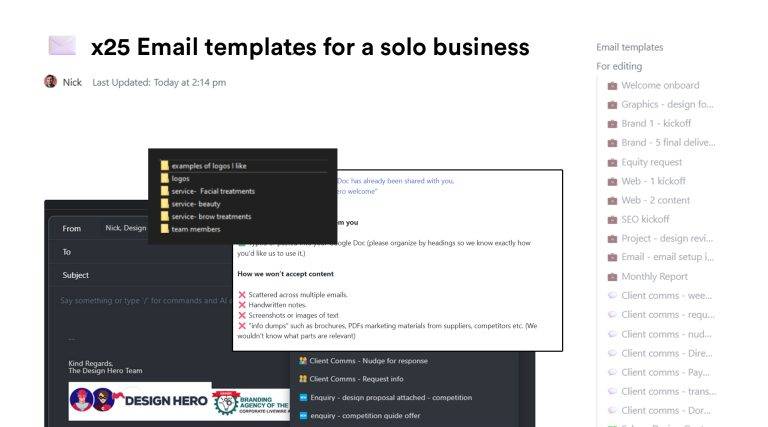
Setting healthy boundaries doesn't have to be hard.
Subscribe for instant access to x25 foolproof email templates to set boundaries as a solo business.