8 years ago, I worked at a signage company doing “design” work that in truth could have been done by anyone who could use a computer.
I had an argument with my senior, about the tool the company were using to create the design assets.
It was the wrong tool to use, and each file had to be created from scratch.
I had pitched spending 1 day to retool, and develop global templates which would save hours every day.
Multiplied across x5 designers on the team, this would save the company thousands in wages, with zero costs.
Of course, it didn’t happen.
Them: “I’ve been here for twenty years, and we’ve always done it this way.”
Me: Well that’s even worse, you’ve been using the wrong tool for the job for 20 years. 😅
Needless to say I wasn’t there for long.
Many people in corporate environments would rather be comfortable than profitable, which is why many people never reach their full potential;
It’s easier to take the obvious route, and do what everyone else does.
People don’t like doing things differently and they don’t like change.
Here’s a few phrases that drive me nuts:
“you’re just being anal”
“that’s overboard, it only takes 5 minutes”
“why are you always trying to fix it when it isn’t broken?”
“there’s no point in being a perfectionist”
“this is what we’ve always done”
The design team would waste hours trying to keep up with the workload, wrestling with outdated tools, instead of taking a few hours to build a new way of working.
But it was more comfortable to stick with what they knew, even if it was costing time and money.
I used to think I was was the one being weird:
I’ve always liked to optimise things; The flaws are always obvious to me. And the improvements to make clear and necessary.
Now I realise it’s a superpower and it lets me operate the way I do.
As businesses scale, this wasted time and money will be multiplied.
Large corporations may be able stomach to stomach this level of wastage, but as lean, solo business, freelancer, or small business, you cannot.
This waste is multiplied in a solo business as you scale, and if you try to brute force your business, then you will ALWAYS be working longer hours.
If you want to work less, you need to systemise your business to multiply your outputs without putting in more time.
Why you can’t scale your business without burnout
Many solopreneurs bounce their way through projects with no clear systems, fighting fires, chasing payments, responding to emergencies, reacting to whatever their clients dump on their plate.
A lot of the “annoying” client behaviours you experience are not bad behaviours at all, they are simply reacting to your chaotic process.
- If you don’t give the client a tool to organise their feedback, their feedback will be unorganised.
- If you don’t tell them what comms channels to use, they will contact you on whatever app they usually use
- If you don’t provide deadlines, they will leave things to the last minute.
- If you have no process, the client will make up their own.
There are no bad clients, just badly managed clients.
When the process is different every time, you’ll be scrambling to catch up, familiarising yourself with different tools each time, so the client experience will vary every time.
It is impossible to scale a business this way.
A business with no process is like walking a dog outstretched at the end of the leash;
The dog will walk wherever it likes, lunging at every distraction.
🔥 Time to take responsibility folks, those fires your fighting in your business are actually process failures.
Without these systems and processes, every project feels like starting from scratch.
You’re treating your inbox like a task management tool, juggling client requests, chasing feedback, sending invoices manually, and trying to remember what’s next.
Chaos!
That chaos doesn’t just burn you out, it bleeds into the client’s experience, making them feel like things are disorganised.
Fix your systems, the chaos stops:
Projects run smoothly. You’ll waste less time on admin. You’ll sleep better too.
That’s why good systems are multipliers for a solo business.
Your thinking is multiplied by your systems.

Now that I run my own business, I have freedom to implement & improve.
I continuously improve my processes, systems and strategies, and I encourage my team at Design Hero to point out the flaws in my own thinking, and instead of working mindlessly, build new systems that scale.
The hidden cost of chaos in a solo business
If you stick to what you know, instead of what helps you grow,
then the only way to get ahead is to do more and work harder.
This is what most people do:
More leads, More ads, more engagement, more AI, more shiny objects…
But you won’t change your life by doing more of what you’re doing now.
Being too busy is the no1 cause of burnout in business owners these days.
When we’re busy, it’s tempting to think:
“I know there’s probably a better way of doing this annoying task, but it only takes 5 minutes I’m too busy, so I’ll just do it quickly now.”
This is a mistake.
Sure it takes 5 minutes now.
And another 5 minutes the next time.
and the next time. and the next time. and the next….
The true cost is the time lost to context switching, and the damage from interupting your mental flow. It’s fake productivity.
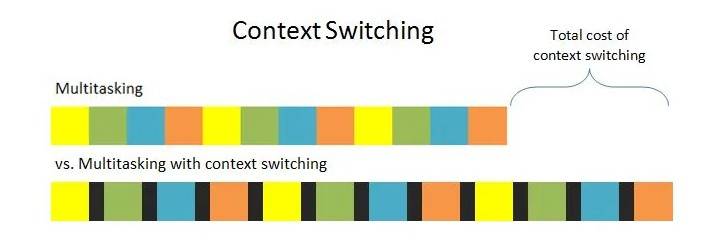
This is how solopreneurs get stuck being an employee in their own business, wasting their days buried in admin, instead of growth tasks.
If you have to work more hours to produce more profit, then you’ll ALWAYS going to be working longer hours.
If you want to work less, you need to systemise your business to multiply your outputs.
So if you spend most of your time working IN your business instead of ON your business, then your most important job right now is carving out an hour every day to build systems in your business:
Spend a little more time NOW to set up a system which will save much more time LATER, allowing you to run your business to maximise profit, freedom, and stability without just working harder.
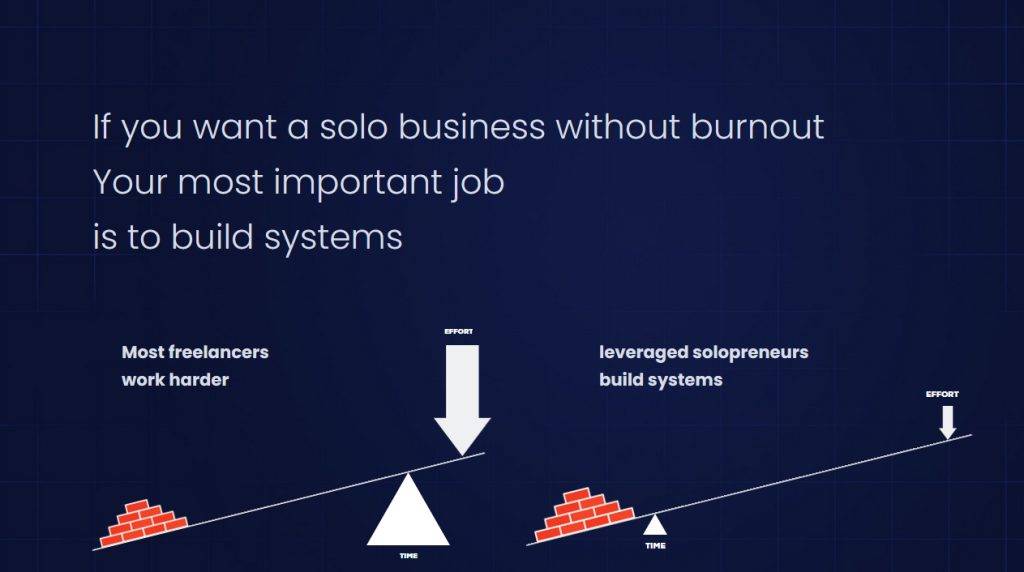
Systems multiply your output & reduces your working hours
The most common mistake freelancers make is trying to scale uthe business before they have the foundations optimized;
Good business systems are multipliers.
Scaling bad inputs multiplies bad results.
Remember: We want to build a lifestyle business without burnout.
So how do we get more output without just working harder?
you need to multiply your time
you need to achieve the same result with less.
You need leverage to achieve the same results without working more,
and consistency to work on the right things for long enough for them to get results.
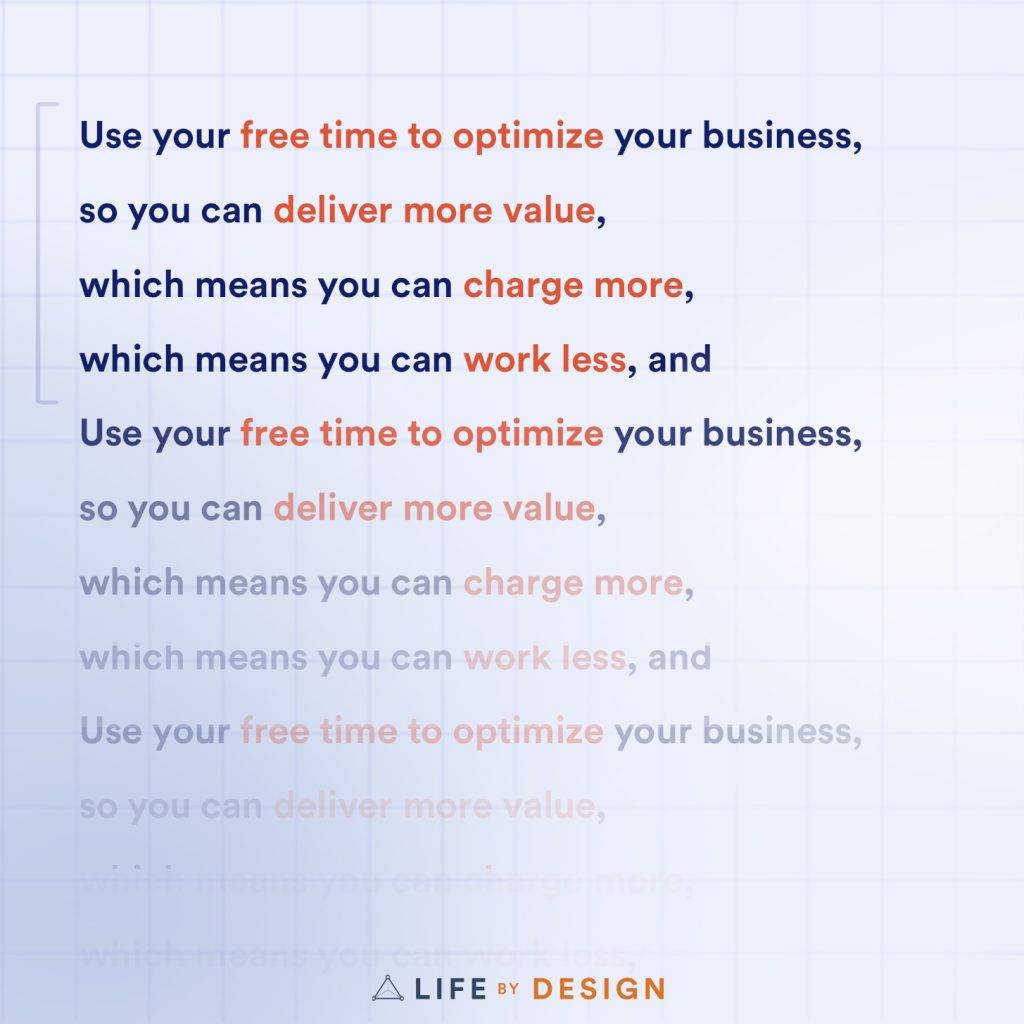
Systems keep you consistent long-term
We live in the age of distraction: We start projects but usually get sidetracked.
We aren’t consistent for long enough to gain the benefit.
Shiny new objects, new ideas and distractions are everywhere:
Every app on your phone and your computer are designed to derail your train of thought. So it’s no wonder most business owners struggle to stay consistent or stick to a plan for more than 3 months.
The gurus like to say, “just show up every day”.
But trying to show up every day is exhausting 😩
We all know that we should be working on those goals we set ourselves. But working on them every day is another matter…
As a result, what happens is we put in the hours,
but our efforts are diluted so much that we never make any meaningful progress on our goals.

Ideally we need to make sure our energy is put into one direction, and we move in that direction every day.
But we live in the real world; things come up.
The reality is you’re NOT going to be able to commit to every single day.
But that doesn’t mean you can’t show up every single day.
“You do not rise to the level of your goals. You fall to the level of your systems.”
– James Clear
Most tasks can be batched into a process
Most processes can be systemized
Most systems can be automated
And most automations can be scheduled.
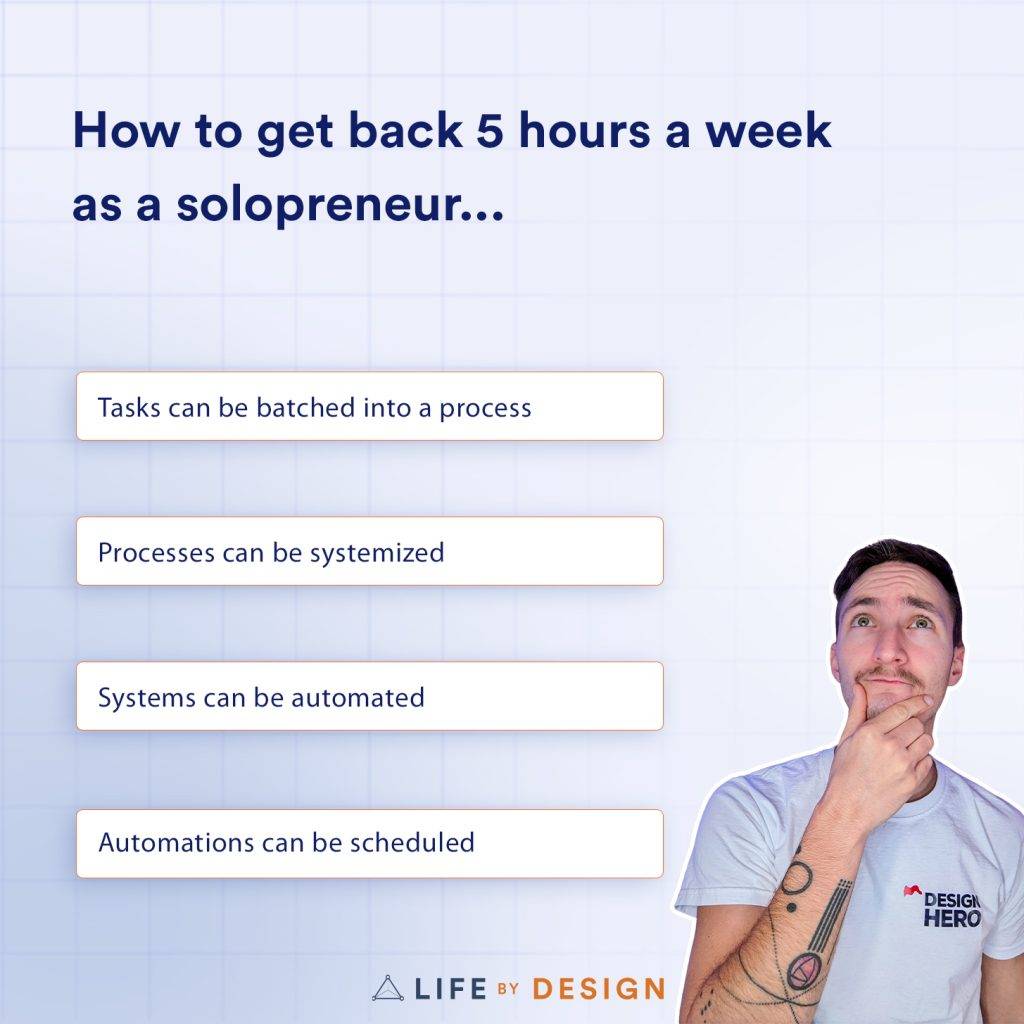
My framework for building systems in a solo business
Systems are how you show up every day, even when you don’t feel motivated or enthusiastic about it.
People are fallible. Systems are bulletproof.
Learning to build systems for each part of your business is how you consistently grow 1% every year, every month and every day.
So now I’ll walk you through you how to systemize and optimize a freelance business in baby steps,
Plus we’ll look at a task management system to organize your business in one place so you can manage a business without burnout, and scale your business by delegating or outsourcing the monotonous parts of those projects.
Systems can be simple, or the can be complex. But usually simple works best.
Systems are usually a combination of:
- Processes
- Templates
- Automations
- Tools
- Decisions
- People
- Tracking
- Feedback loops
In short, you write down your processes,
Then you improve the process,
Then you automate, delegate, and delete as much of your process as you can,
So you have more mental space and more free time.
I use this framework to build systems in my business, and it’s the same every time:
- 📃 Document
- ⚙️ Process
- ❌ Eliminate
- 💎 Optimize
- 📁 Template
- 🤖 Automate
- 👪 Delegate
📃 Document
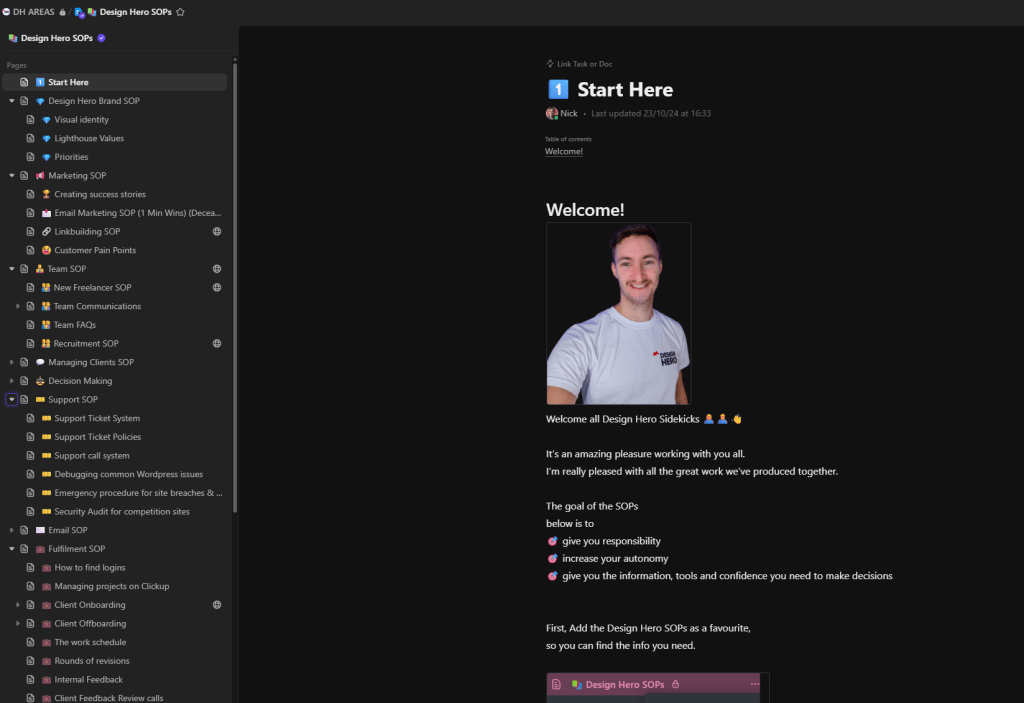
It starts with writing down your process.
These are often known as SOPs or “Standard Operating Procedures”.
Call them whatever you want; it’s how you do things in your business.
You’ll have to figure this out, before you can optimize the way you do things.
This is not just for projects, this applies to every part of your business.
You can’t optimize your process if you don’t know what the process is.
SOPs are the first step in systems that helps you do both and build a systemized business without burnout.
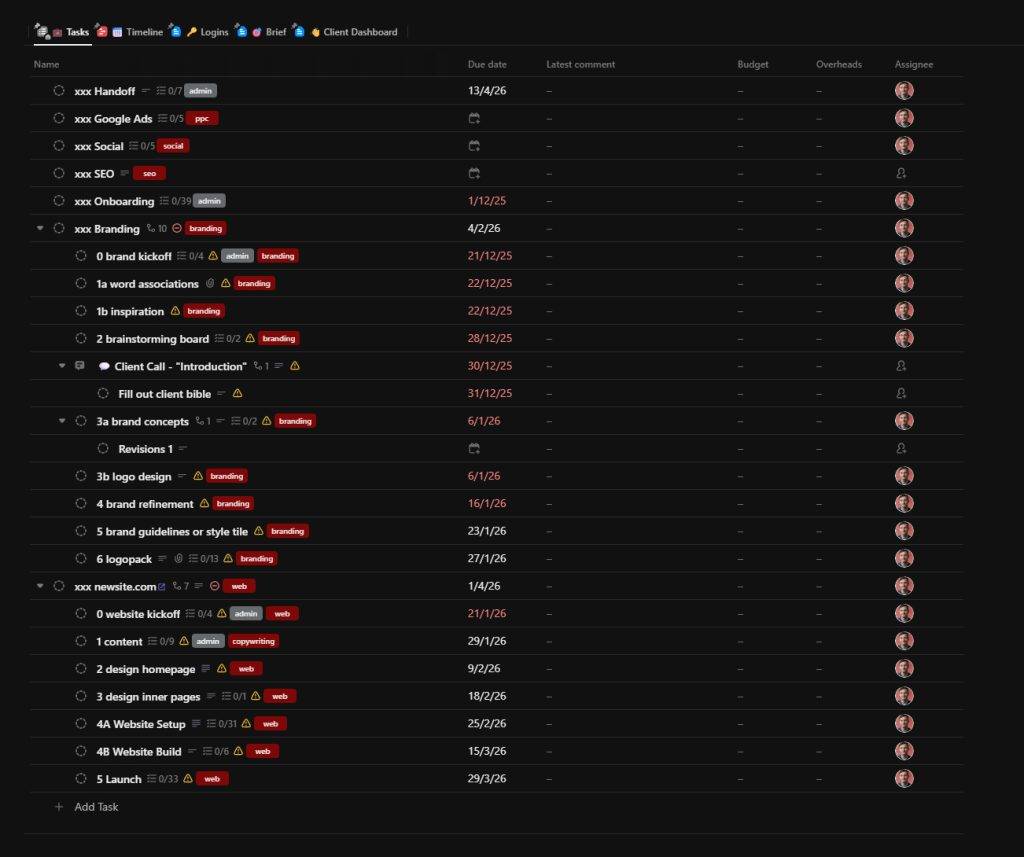
So write it down. Start writing your overall process as bullet points. Break down your process into phases that you will follow for each project. Create checklists under phase to break it down even further.
Now you can visualise what’s working and what’s not.
As you scale, your business will grow in complexity.
You’ll want to take this simple document and replicate it in some kind of software like Clickup. This will become your project management software, second brain and knowledge hub. You can dive deeper into creating SOPs in LBD#75 “how to create SOPs for a solo business”
⚙️ Process
Now you have a rough step-by-step document describing the steps of your system.
SOPs teach people how to do it.
Your process is the thing that actually makes sure the “how” gets done.
Setting up your system means combining your the SOPs, templates, automations, delegation etc into a repeatable process which can run on autopilot, with minimal human input at critical points.
You can now create a “first draft” of your system…
No system is permanent, systems are fluid, they are always being improved, adapting and changing according to feedback.
But once we have a basic system we can start to improve it.
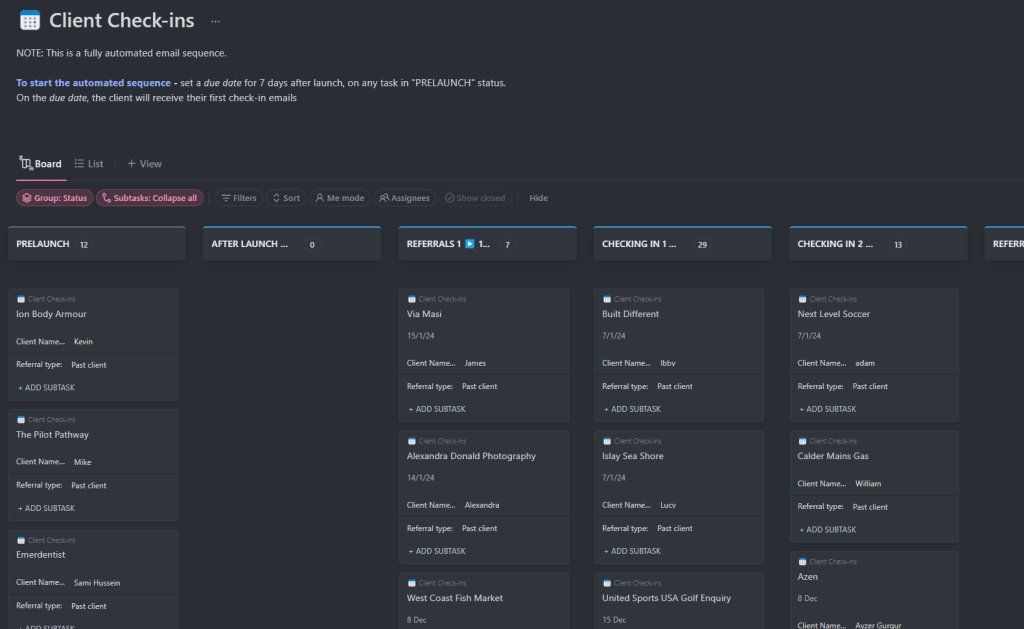
A system might start as a simple excel spreadsheet with a checklist, and then grow into automated software, such as this fully automated client check-in system built in Clickup with automated email templates and triggered automations.
An example:
This system started as a simple spreadsheet with reminders for me to check in with old clients for referrals and grew into a fully automated lead generation system which generates 6 figures+ for my business every year, on autopilot.
❌ Eliminate
Parkinson’s law states that 20% of your efforts will have 80% of the results.
In other words, 80% of what you’re doing isn’t impacting results, and can be eliminated.
I often start trying to solve a problem in my system, only to realise I what I should be doing is stop that problem occurring in the first place.
The prevention is always better than the cure.
Here’s some questions to ask yourself:
- Do I really need to do this?
- Does this improve the end result?
- Can I get the same result without this step?
- Does this impact client experience?
- Does this speed things up or slow it down?
- If I stop doing this, what will happen?
If you can skip this step and achieve the same result, remove it.
If you can stop this, and nothing bad happens, remove it.
An Example:
When designing websites, we found that our usual process of starting with basic wireframes was leading to a lot of revisions at the end of the design stage:
We questioned this and it turned out clients weren’t able to imagine how the website would look.
So instead, we removed the wireframe stage, and skipped straight to presenting high fidelity designs.
This did cost a little more time at the start of the process, but saved a lot of time later in the process, with less requests for redesigns, which meant less meetings too.
It also shortened the overall project timeframe.
As a result, development time went down, profit margin went up,
AND we increased our value to the client, since we could romise a quicker turnaround, which meant we could also charge higher rates.
💎 Optimize
Just because everyone’s doing it one way, doesn’t mean you have to.
Keep an open mind here. Nothing is sacred.
Maybe you don’t need to do networking after all. Or maybe you don’t do free consultations anymore.
Maybe you don’t need to get a signed contract before starting.
Questions to ask about your process:
- What is causing the most problems?
- Where are the bottlenecks?
- Where do I have to rely on someone else to progress?
- What can I do differently?
- What apps or systems can streamline that process?
- How can I get to the same end result in a more direct way?
- How can I speed things up?
- What can I remove?
- What have I been doing for years without thinking about it?
📁 Template
If you’re going to do something more than once, don’t start from scratch.
Create a checkpoint you can use to skip the repeated parts.
If you repeat the same thing more than once for every project, create a template to shortcut the same parts every time, rather than starting from scratch.
Emails, invoices, project folders, website preinstalls, social content, documents, meeting agendas…
Almost every area of your business can benefit from templates.
An example:
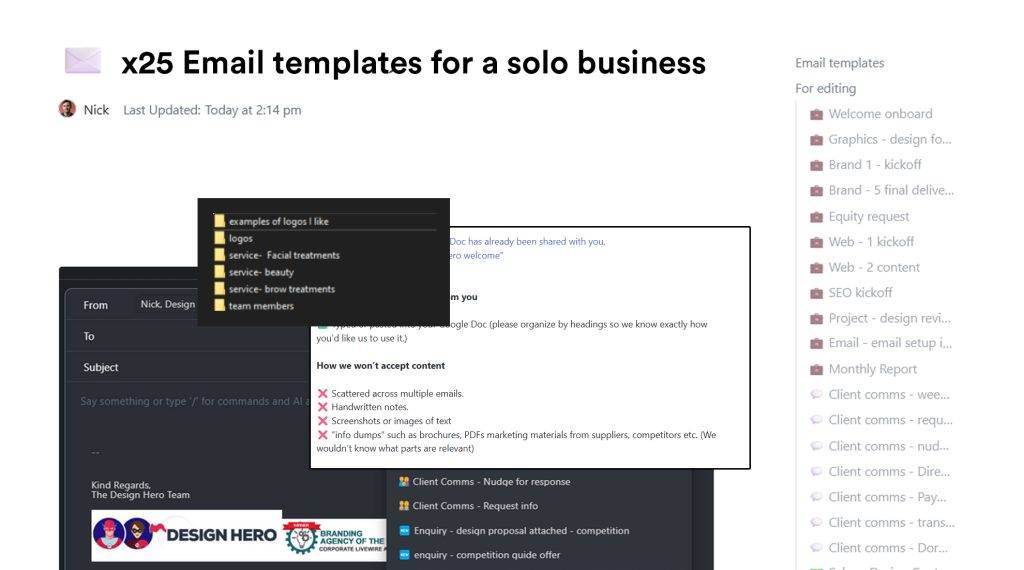
I keep email templates for almost every type of email I send, saving hours every day.
These aren’t your AI-generated slop, these are super clear, time-saving emails for the discerning solopreneur.
🤖 Automate
Most repetitive tasks can be automated in some way. There are many tools and apps out now which integrate beautifully, to remove manual actions needed between steps.
When you have a system running by itself without your input, you will feel like a superhuman.
Here’s some questions to ask yourself:
- Does this step require human intuition, or fuzzy logic?
- Does it run on a set of logical rules such as IF, THEN?
- If so, can I replace this manual action with automation?
- Where can I use apps to remove human input or actions?
- What actions or emails can I trigger using automations?
- What new apps and tools have been released that replace human input?
An example:
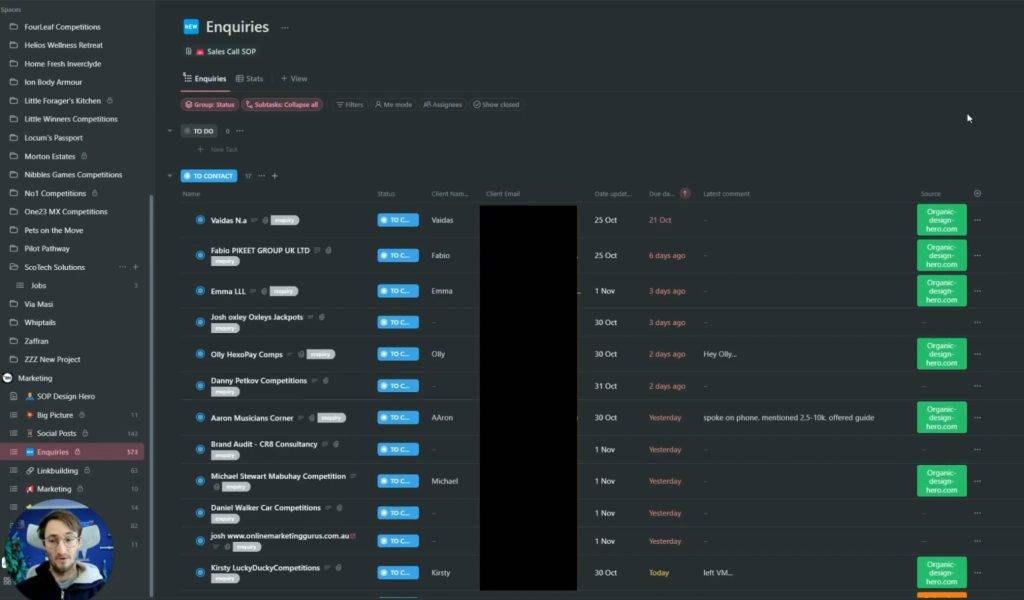
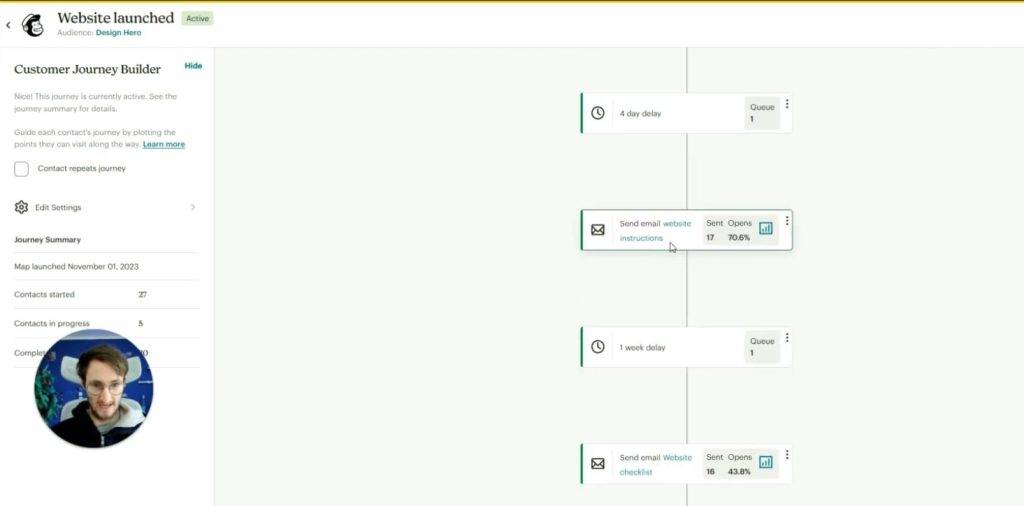
At the end of each stage of a project we send an email to the client letting them know next steps. This template email can be automated, triggered when the status of a project changes:

👪 Delegate
My last resort because I don’t like to scale the overheads in my business if I can help it.
If you’ve done all the above, and the system still needs human input and intuition, then it’s time to delegate to someone who can do it just as well as you, so that you can spend your more valuable time somewhere more critical, on a task that requires your specific knowledge.
Is this a valuable use of my time and skills?
Your time is your most valuable resource, and your skills are a measure of your leverage.
The math is simple:
first, you’ll need some idea of how much you charge.
If your effective hourly rate is £100, and creating social posts takes you an hour, spend that hour to make £100 and pay someone £25/hr to create your social posts.
What simple tasks can you start outsourcing to a VA, or train someone to do?
if it’s a permanent part of my business is it time to hire?
If you feel you’re ready to delegate your first tasks, here’s my low-risk method to hiring the right person.

♻️ Review & repeat
No system is permanent: As you grow your systems will break.
Review and reassess regularly.
Update your SOPs to reflect any changes.
Even if you work by yourself, it’s important to keep your documentation up to date.
Systems = scale – burnout.
Eventually your systems will be your most valuable asset that will help you multiply your outputs and build a business with leverage and freedom
Your systems are record of your unique way of thinking that you can repackage and sell;
Which you can repurpose again and again for growth & for peace of mind
With SOPs and systems in place, what used to take you 2 days will take you 2 hours.
Without my systems I would be an employee in my own business;
trapped under the weight of labour,
buried by an avalanche of admin,
suffering from undue stress
instead of doing high-value work using my unique talents.
If you want to scale you need two things:
1 you need to produce more output without more input.
2 you need to be consistent in your methods and processes to free up brain power.
Systems are how you achieve both.
Subscribe for instant access to my masterclass on systemising your one person business.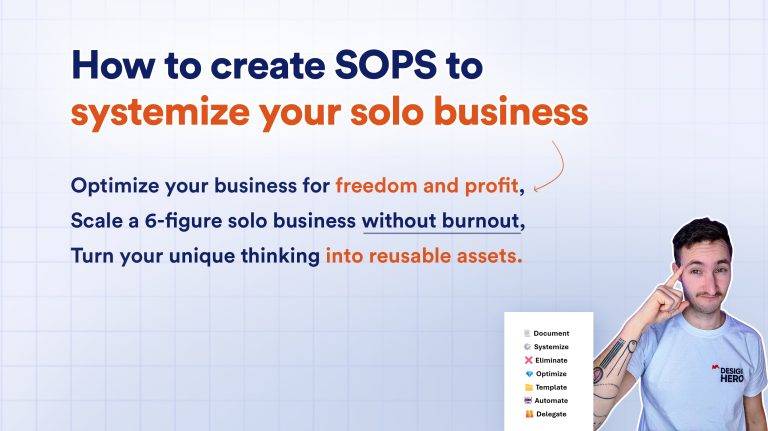
Are you scrambling and firefighting without a repeatable, recognisable process?
❓ 0:00 Why you can’t scale a solo business without SOPs
🧱 1:10 A system for building systems
🔨 2:40 tools & apps don’t matter
📃 4:20 1 document
⚙️ 5:00 2 Systemize
💠 5:50 3 optimize
📁 6:20 4 template
🤖 7:00 5 automate
👨👩👧👦 7:30 6 delegate
♻️ 8:20 7 review and revise
🥅 8:40 capture your process AND your thinking
📊 9:20 Project management for designers
📈 10:30 Start simple, and add to it
🤯 11:30 Don’t overthink it, your process will change
💥 11:40 Your SOPs are a reusable asset and resource
ℹ️ 12:05 Summary