Today I’m going to teach you how to develop SOPs.
Sounds boring, right?
But SOPs are the thing that helped me half my workweek, and reach a record-breaking profit month at the same time.
SOPs, or ‘Standard Operating Procedures‘ are documents that outline how we do things in our business.
But they’re far more than that; they are a long-term asset that lets you repurpose parts of your business into assets you can sell, or delegate parts of your business to team members so you can scale.
They’re also one of the best ways to manage your business without overwhelm.
SOPs might seem boring, but they are one of your most valuable assets, that allow you to…
- Repurpose parts of your business into digital products that you can sell
- Create digital templates that you can repurpose into content, books and training modules
- Capture your unique way of thinking and start selling consulting.
- Delegate parts of your business to team members with ease.
- Scale and manage your business without overwhelm
- Multiply your outputs without increasing hours
- build leverage and freedom
- reduce overwhelm
Why you feel burned out every time you try to scale your business
Reason 1 for burnout in a solo business
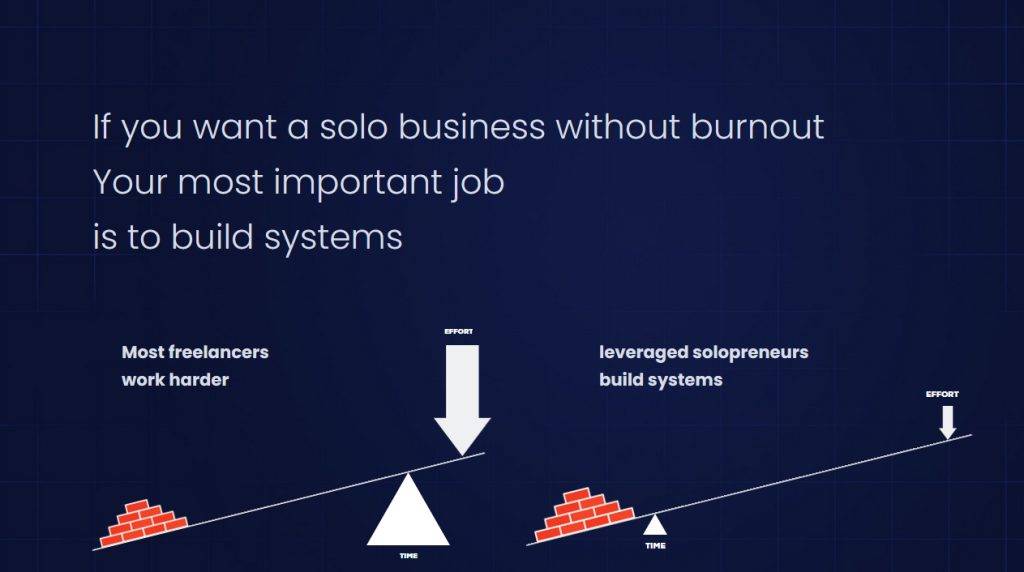
If you want to scale, you need more output.
Most people try to do this by working harder:
- more hours
- longer days
- more effort
- more hustle
The issue with this “sledgehammer” approach?
If you have to work harder to produce more profit, then you’re always going to be working harder and you’re always going to be working longer hours.
Most solopreneurs are hard workers.
This can be an asset, but also a liability.
They fall into the trap of bad thinking:
They think if they want more profit, they’ll just work longer hours, to produce more output, and earn more.
This isn’t sustainable, and it’s not a growth strategy.
We have to work smarter, not harder.
Reason 2 for burnout in a solo business
The second mistake solopreneurs make is trying to scale too early, before they have their business figured out properly.
The crazy hustle might feel exciting, it may feel like you’re making progress, flying by the seat of your pants, making things up as you go along.
This will work for a while, but again, it’s not sustainable!
You’re building a castle on shaky foundations. Eventually it’s going to crumble, and that’s when you get burned out.
When solopreneurs make the mistake of trying to scale, before they have documented or optimized. They end up scaling, but at the same time they multiply the chaos:
Scaling bad inputs means more bad outputs.
x10 piles of shit, is just a bigger pile of shit.
What we want instead is a lifestyle business without burnout.
That means getting the foundations right first, then systemising them.
So how do you produce more output without just working more?
You multiply the time you already have.
Time is your most valuable asset. There is only one of you. We all have the same number of hours in a day, so you need a way to get the same results as before, but with less effort. We do that by building systems in your business.
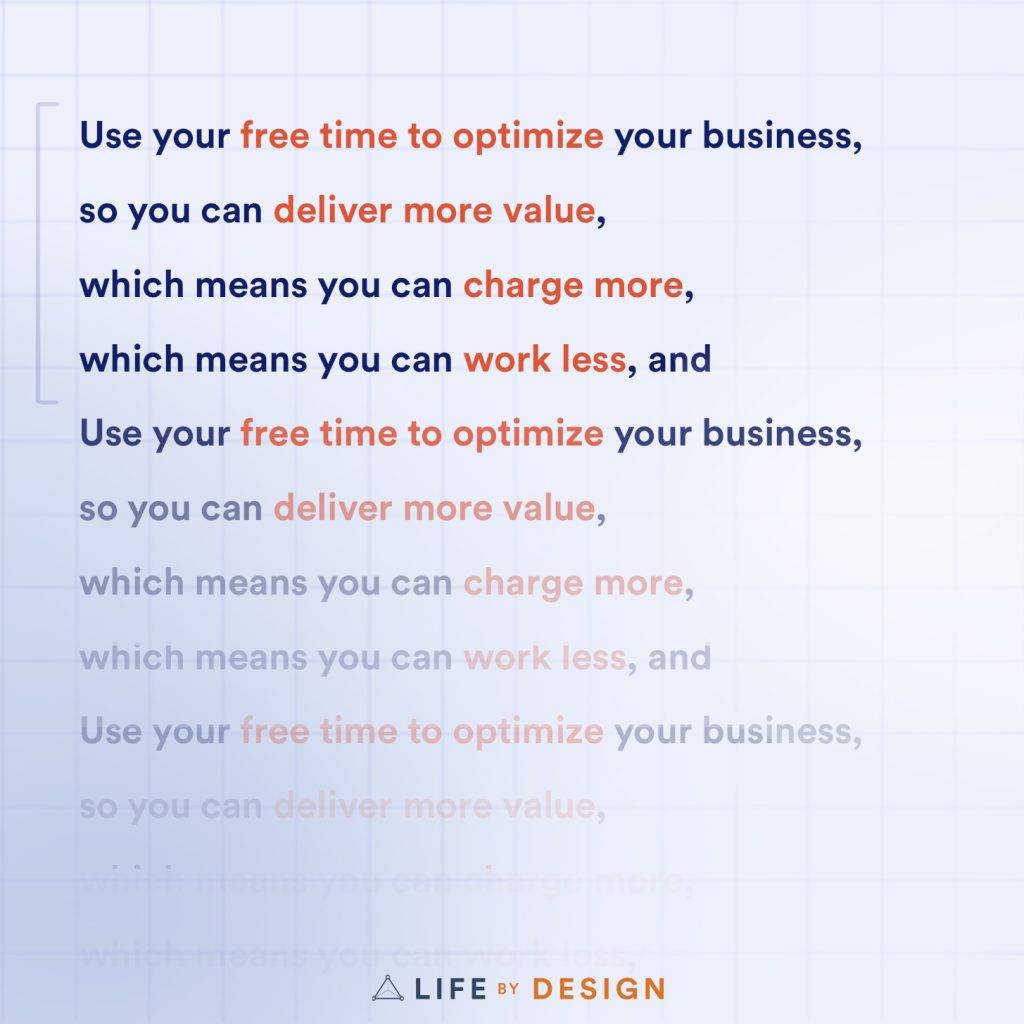
Systems are a self-multiplying flywheel for business growth:
Why SOPs matter for solopreneurs
If you’re running a solo business, SOPs are the only realistic way to scale a solo business to six figures and beyond without burning out.
What used to take me days now takes me hours, because those intermediate assets and processes are stored in my SOPs and I can batch process, automate or delegate my newly optimized process.
This is where SOPs come in:
- You can’t delegate without a process.
- You can’t have a process without a system.
- You can’t optimise the system unless you know what it looks like.
It sounds simple. Simple doesn’t mean easy.
SOPs are the only way that you’re going to scale a business to six figures and beyond, by yourself, without just getting totally burnt out.
Even if you work by yourself, it’s important to create SOPs.
Writing your SOPs is a process which will reveal lots of tasks you can optimize, improve or even eliminate entirely.
Don’t wait until you have a team to write SOPs. By then it’s too late. You want your processes documented and optimized before you make your first hire.
So now I’ll walk you through my full process for how I systemise inside Design Hero, my multi-6 figure design agency.
After systemizing my business, my average workday is between 3-5 hours, which I manage by using these systems.
I’ll show you how to systemise and optimise your freelancer or solo business in baby steps, and how to organise everything in one place so you can manage multiple projects without getting overwhelmed.
Tools for building SOPs
Notion or ClickUp
This process is tool-agnostic. It doesn’t matter what you use.
But you’ll want some kind of hub to store all your documents and SOPs.
Many use Notion. I personally prefer ClickUp.
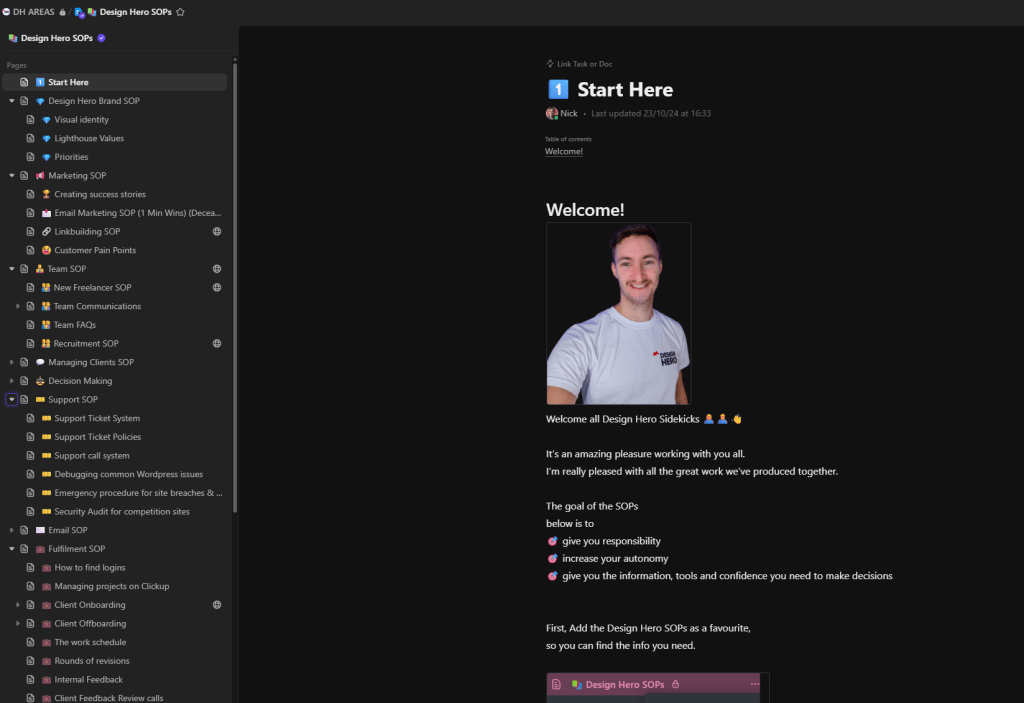
Notion is great for note-taking, but for project management and automatoin for ClickUp is stronger and I like to have everything in one place.
In my ClickUp, I track everything for Design Hero:
- brand and marketing
- email marketing autmations
- case studies
- link building
- team training
- customer pain points
- and more
There’s a full walkthrough tour of my Clickup envrionment in this article “complete management tool for a one person business”
Loom
Sometimes a video is better than text for explaining complex subjects or visual stuff. You can also do video SOPs using Loom, apparently I’m in the top 2% of users for this tool.
Scribe
I’ve also used Scribe for creating sets of instructions, just record your steps and Scribe turns it into written instructions. Works best with simple step by step tasks for delegation.
Start with a small project or task, not a blank page
When I started writing SOPs, they were basically one line each.
If you sit down and try to write an SOP from memory, you’ll often go blank and think, “I don’t even know my process.”
That’s normal, because you often run through your process on autopilot, and may not even be aware of all the steps you take.
A better approach:
- Start with a real project.
- Run through your usual workflow.
- Reverse-engineer what you actually did.
- Imagine you were describing each step to someone with zero knowledge or skill
- Write down each microstep.
What this looks like in the real world
In my ClickUp, each SOP isn’t just “tasks.” It’s almost like a mini course.
I document several layers:
- The broad goals and WHY of each phase.
- People make better decisions and have more autonomy when they know WHY
- The step-by-step actions.
- These must be as small as “Go to this url, click this button…”
- Deliverables
- The final outputs you’d like to see
- Examples
- A good example
- A bad example
- The thinking process
- WHY did I do this instead of that?
- The thought process behind any fuzzy logic
- Decision branches (IF this THEN that)
Note several things in the example below:
- I include an an index and TOC for every SOP
- I include a video walkthrough of me going through the whole process
- I include text instructions for each microstop, even if it seems obvious.
- I include screenshots and arrows of where and what to click
- I include links to any reference or related documents
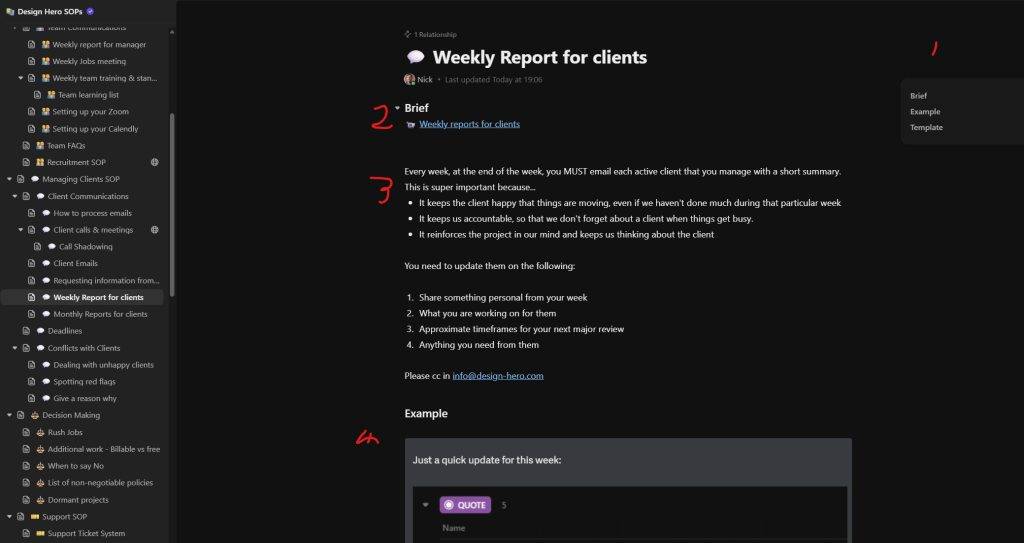
This example is for an Informational SOP. Some SOPs may be more related to tasks or ongoing projects…
A template for SOPs
If your SOP is related to tasks or projects SOP should include:
- Summary
- Deliverables
- Recurring responsibilities
- Who
- What
- How many?
- Deadlines
- Examples
- good
- why is it good?
- bad
- why is it bad?
- good
- Tracking
- KPIs, measureable, specific
- Who is checking and signing off on deliverables?
- How do we measure success?
- How do we know wht “enough” looks like?
- When do we stop?
Here’s an example of an SOP I use for task-centric briefs:
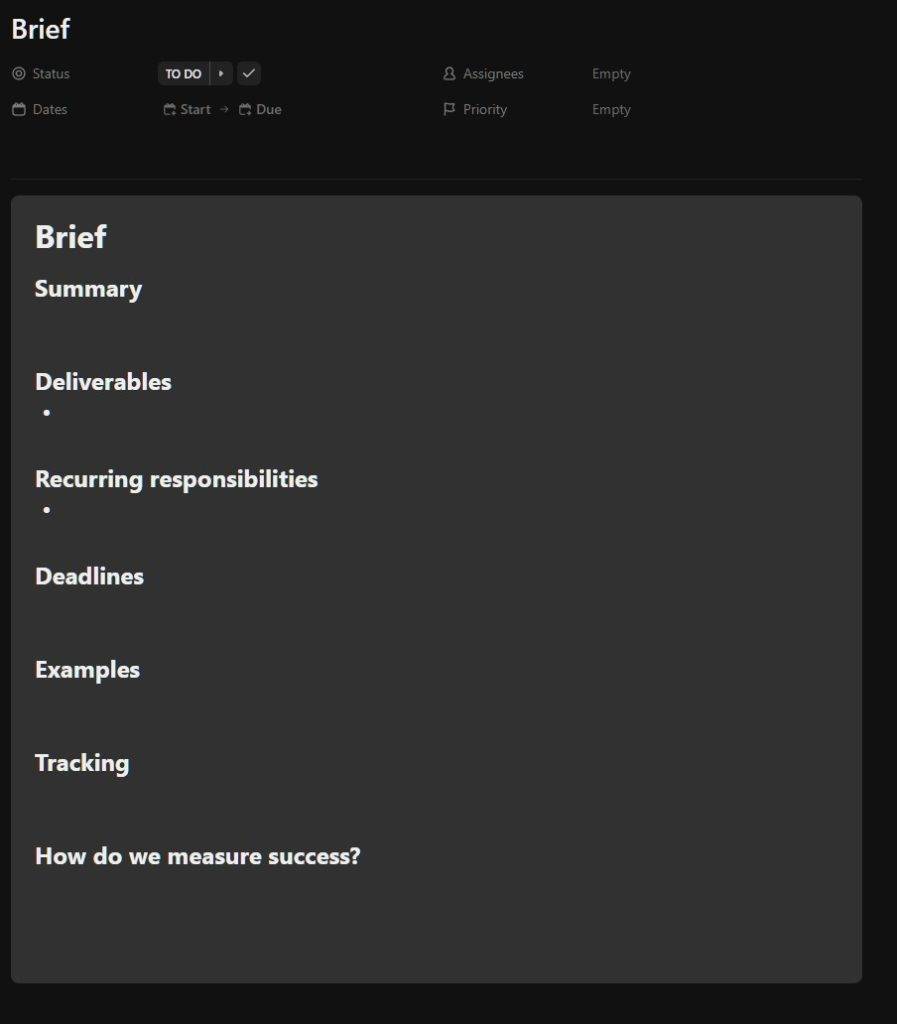
So any new freelancer could come in and understand:
- how I design a brand
- how I think
- how I run projects from start to finish
Over time, your SOP can grown and turn into a reusable project template…
My project template structure
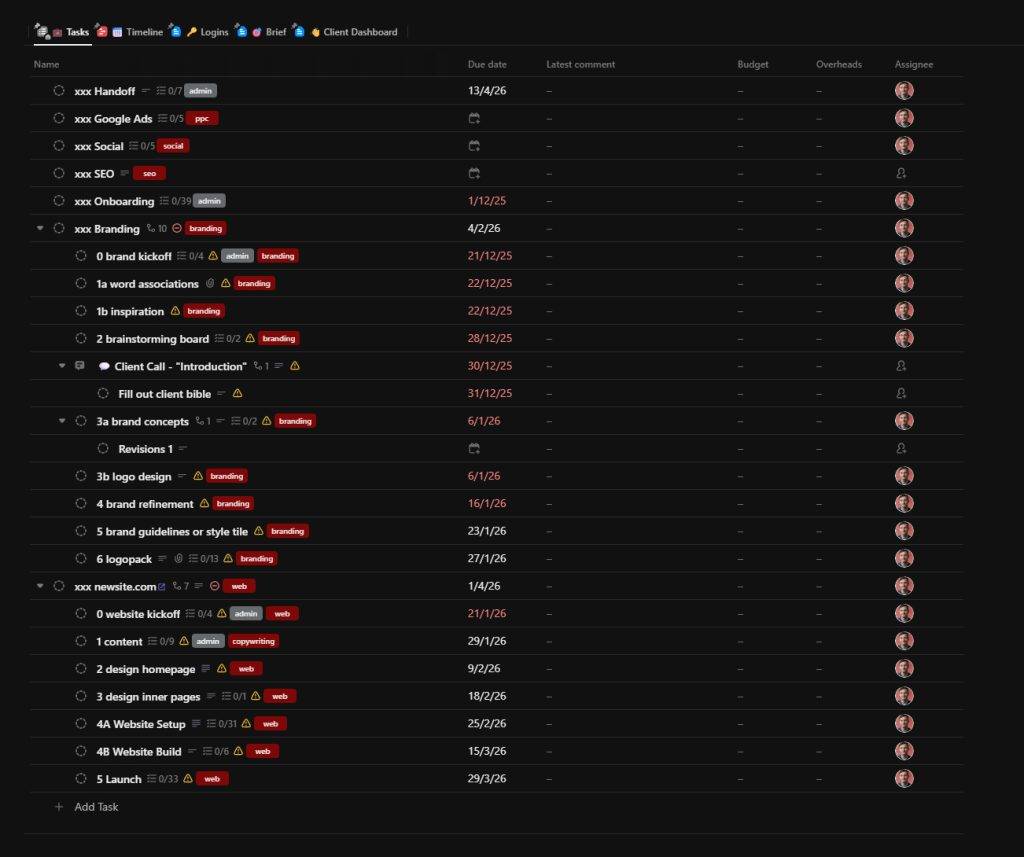
For each new project, I use a template that includes:
- Links to resources at the top
- A timeline I can share with the client
- Login details
- Onboarding questionnaire
- A Google Doc for website content
- A shared folder for client files
Then, under each stage, I include tasks with:
- briefs
- checklists
- step-by-step to-dos
Example: website setup might include a detailed checklist for the build stage.
I update this constantly each time I update my process
- If I stop doing something, I delete it.
- If I add a new best practice, I add it to the template.
This is what a project folder might look like, with links to login docs, brief, client comms and SOPs along the top:
The easiest way to create SOPs (without overthinking)
Set up a project and do the work.
Afterward:
- Look back at what you actually did.
- Update your SOPs to match reality.
- Improve the process once you can see it written down
You can replace steps with:
- Loom videos
- questionnaires
- automations
- templates
A great trick is to imagine you are hiring someone, then write the instructions for them. That pressure forces clarity.
But don’t wait until your first hire. By then it’s too late. When you hire you want to have your SOPs in place for maximum efficiency.
Writing your SOPs will also give you clarity on how to optimize your process.
Once you have an SOP you can start to optimize, systemize and automate…
My System for building systems
Once you have documented a task, or a process, or a project and created your SOPs for it, you are ready to start optimizing and systemizing. I use a simple process to systemize my solo business:
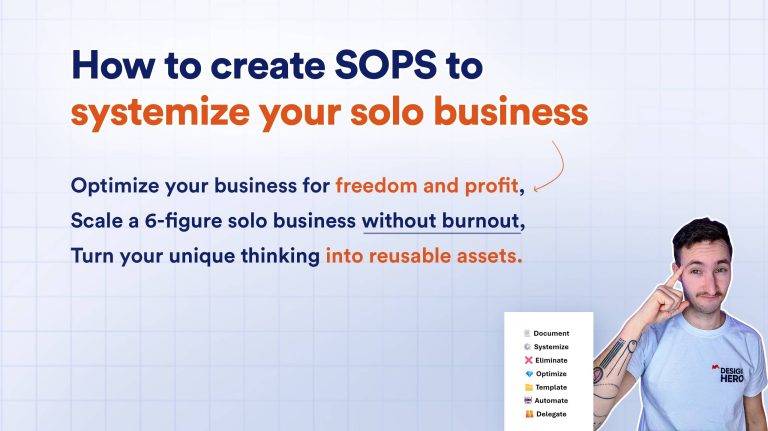
- Document
- Systemise
- Eliminate
- Optimise
- Template
- Automate
- Delegate
There’s x2 things you can do next
- Check out the next article: “How to systemize your solo business“, where I’ll cover my 7 step process for systemizing your business:
- You can subscribe for instant access to my masterclass on creating SOPs
Want clear, streamlined SOPs to optimize every part of your business?
Subscribe for instant access to my masterclass on systemising your one person business.