You know that feeling where you feel antsy, and twitchy, but also somehow exhausted at the same time?
Where you have loads of stuff to do but you can’t seem to start a single one of them?
Where making even tiny inconsequential decisions seems impossible?
That’s decision fatigue:
Your mind is a muscle, it gets tired from use. It will recharge, if you give it a rest.
But in the age of distraction and AI, every time we have a chance for rest, we start scrolling our phones.
Watching Netflix and scrolling our phones is now the top “rest” activity.
Except that doing 2 separate things at the same time is not rest;
It puts a mild cognitive load on our brain which prevents us from recharging properly.
So if you want to feel focussed and make better decisions?
When it comes to turning down the noise, and dialling down distractions, and managing your todo list willpower alone is not enough.
To survive in today’s world, you have to exist in an online environment where every second you are barraged by distraction.
🔹 Make fewer decisions
🔹 Simplify our choices
🔹 Rest our brains properly
How to reduce mobile phone use
I cultivate a healthy distrust of my phone.
I hate my phone, yet I crawl back to it like the most loyal of drug addicts.
A mobile phone is a supercomputer in your pocket. It’s a powerful tool coated in yummy heroin.
It’s a little energy vampire in your pocket, a parasite draining your ability to focus, and sapping your potential to do great things.
Your phone is designed by teams of experts headhunted from behavioural science, gaming, and gambling industries to make it as addictive as possible, using tactics gifted directly from the gambling industry with monstrous names like:
“Reward prediction error encoding”, “Variable reward schedules”, “cycles of uncertainty”, “ludic loops”
I feel tremendous guilt about the short-term, dopamine-driven feedback loops that we have created are now destroying how society works
– Chamath Palihapitiya, former VP of User Growth at Facebook
The goal is to capture as much as your attention as possible.
To steal your attention and spend it on something you didn’t intend.
Have you ever felt your phone vibrating in your pocket, even when you didn’t have it on you?
This phantom signal is a sign of psychological craving.
Congrats, you’re an addict too!
Phone addiction is the new normal
Your phone is literally rewiring your brain.
Because after you put your phone down, your phone is still on your mind,
sneaking in every 5 seconds to tempt you to open it back up for one more dopamine hit.
We’ve all seen that guy on the bus, who can’t sit still, leg twitching for a fix, opening his phone every 10 seconds, scrolling, putting it in his pocket, repeat….
Imagine:
The whole world is technically categorised as addicted or displaying addictive behaviours.
How does this programming affect our behavioural patterns on a world scale?
- The way we interact with each other (or don’t)?
- Our perception of the world, our level of fear and distrust?
- Our ability for empathy, patience, and kindness?
- Our ability to handle hardship and unpredictability?
- Our ability to experience life as it happens, instead of recalling it later as a photo?
Scary sh*t!
But outside the scope of this article. I try not to think about it.
But don’t worry, we’re all in the same boat.
It’s a feature of everyday life now.
This addiction is “harmless” enough that we don’t hit rock bottom, so as a society, we don’t do anything about it; we simply suffer the negative impact it wreaks on our personal, and professional lives and mental wellbeing and call it the new normal.
Remember that social media apps are not playing fair:
Every digital app, device and UX is designed to grab, capture and redirect your attention.
The designers of these interfaces are highly skilled, highly paid, and trained in tricks originally developed for the gambling industry.
So rest assured, it’s no wonder you’re distracted.
Know your enemy
The reason why your phone is the enemy of focus is that when challenged, your brain seeks more attractive things to pay attention to.
Instead of thinking about a problem your brain wants to slip away into something more comfortable.
Ticking off smaller easier tasks just feels better.
And your phone is THE most attractive, comfortable thing around.
It’s as if Ryan Gosling and Ana De Armas had a baby, they stuck in a blender with some Heroine, then stitched a pair of fleece-lined slippers out of it.
That’s how attractive and comfortable your phone is to your brain.
Willpower or discipline alone won’t help you here.
Environmental change is much more effective at reducing screen time than willpower.
You are the weakest link, so remove yourself from the decision of whether to pick up your phone.
Your phone is a tool… but who is wielding the tool?
Our phone is a multitool: it can make calls, connect us with friends, find information, create content, think for us, entertain us. But remember:
These are just features…
The true purpose of the tool; the purpose it’s creators made it for, is to economise our attention.
So make sure you are using your phone as a tool, instead of your phone using you.
Decide how and when you want to use your phone.
If you want to scroll social, fine!
But set a time and limit for it.
Think of it as a diet, or an exercises regime. It takes practice.
This will be uncomfortable at first.
You will fall off the wagon a lot.
That’s because you’re an addict.
So treat yourself like an addict.
Would you let a recovering alcoholic wander about with a fresh cold beer in her hand?
The most effective thing is just leave it somewhere else instead of in your pocket.
Then add as many things as you possibly can to add friction to the experience of using your phone and make it less pleasant.
How to add friction to your phone use
- Make it so I have to enter a passcode each time to unlock my phone.
- Remove icons from your home screen.
- Keep it on vibrate only for calls.
- Turn off all notifications so YOU choose when to check them.
- Reply to texts and calls in batches, once every few hours is plenty.
- Schedule DND mode almost all the time. You can always call them back.
- Turn on greyscale mode permanently.
- Use focus mode to only allow yourself 5 mins of scrolling.
- Remove icons from your home screen. 2 or 3 extra swipes and taps add friction
- Use focus mode to limit apps to 5 mins. You don’t need more than this to do a task on social media.
- Check social media on your computer instead of your phone.
- Use Freedom.to to block apps overnight, and in mornings so you don’t check your phone during critical wind-down and rest time.
- Avoid apps with endless feeds like FB marketplace.
- Only open an app if you have a task to do on it.
- Resist the idea that you have to document your whole life.
But with time it gets less insistent, your head becomes clearer,
Instead of scrolling you are thinking clearly.
Instead of being anxious and crabby for no reason, you are optimistic and engaged.
You’re able to hold your focus for longer and longer periods.
⚙️ A new distraction blocker tool I’m using
We are facing weapons of mass distraction.
We’re going to need our own anti-distraction tools to help us…
I tried SocialFocus which is great if you just want a one-click solution. I also use Freedom on mobile.
It’s a great “one click” solution that doesn’t require much setup.
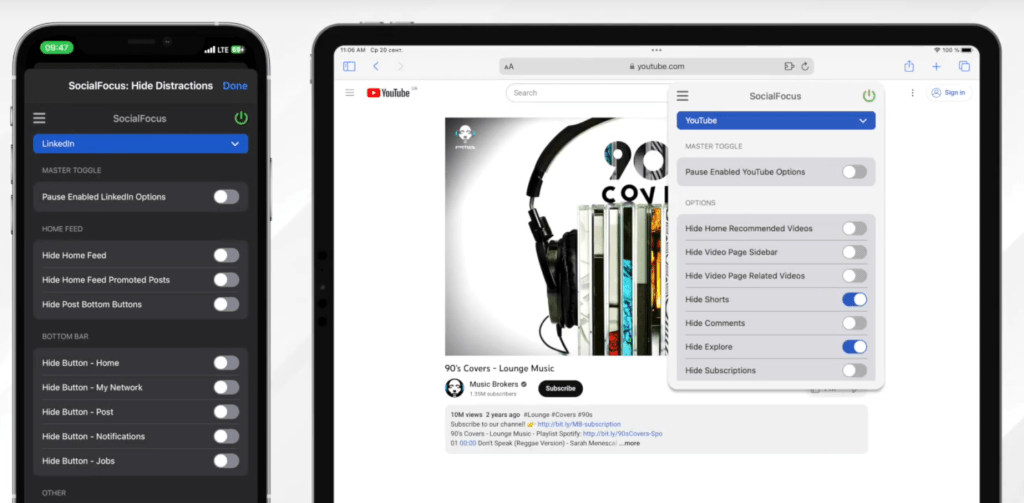
Unfortunately due to my job I still need to USE social media, I just don’t want to be distracted every time I open it.
So I started using “Stylus” instead.
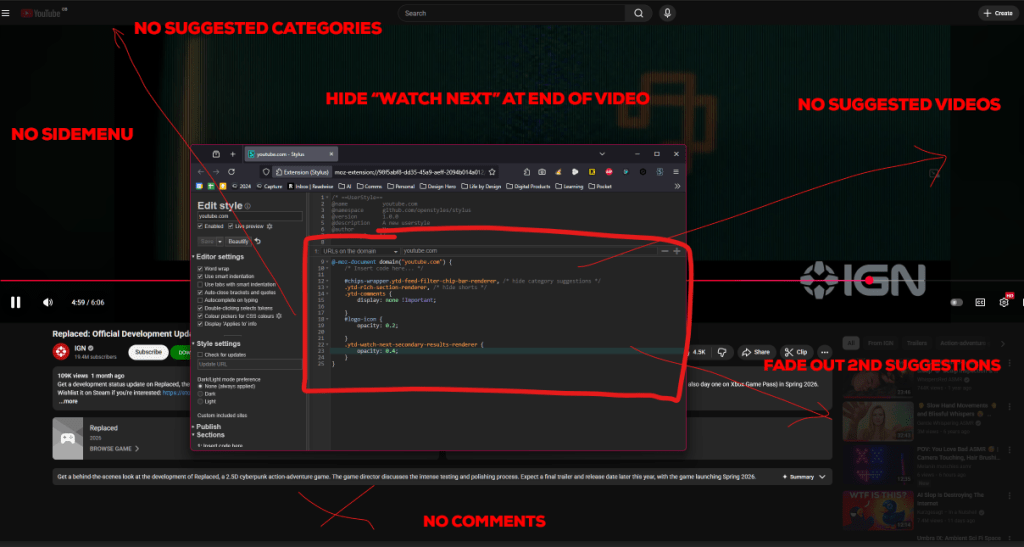
Stylus allows me to customise any website I want like the good ol’ Bebo days. It requires a bit of a learning curve on CSS, but it’s worth it as it will save me hours of focus time every week ,and get me back valuable mental space.
Customise your social media apps to remove the “addictive” parts
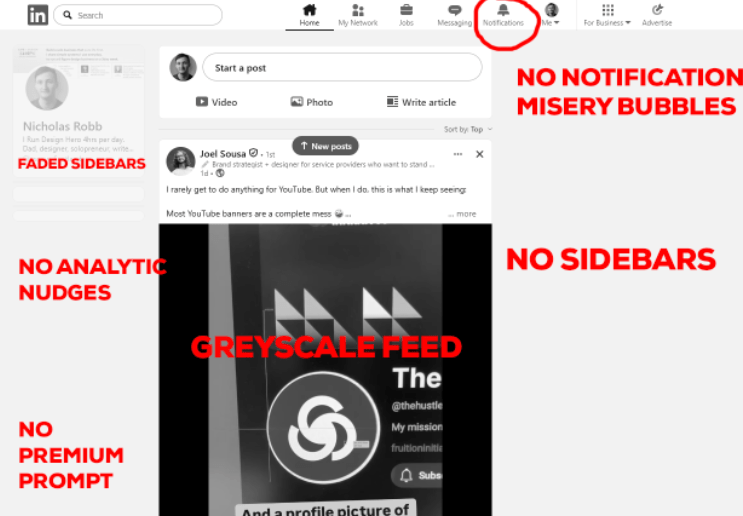
How I changed LinkedIn to reduce distraction
Here’s what my LinkedIn looks like now.
How I changed Youtube to reduce distraction
Youtube is my next biggest distraction;
I go to YT to search and learn. But before I know it, I’m scrolling video game trailers.
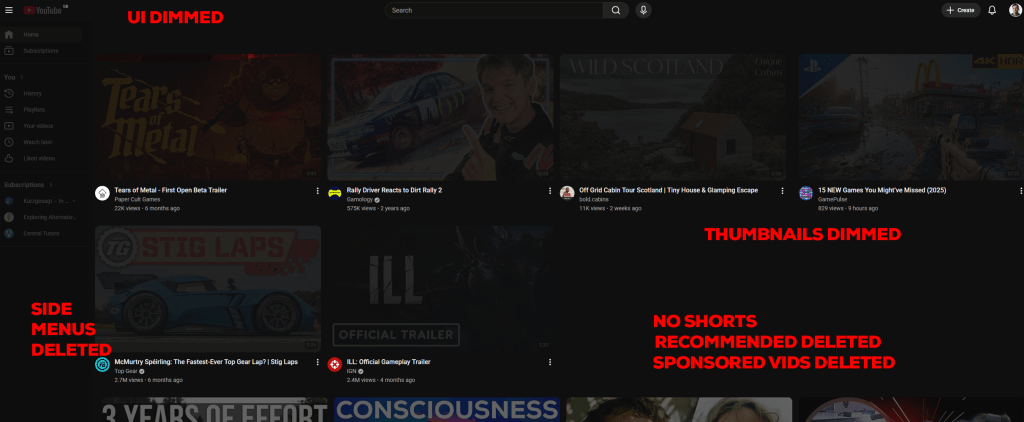
Dimming the thumbnails made the biggest difference, now my eye is drawn to titles, instead of clickbait thumbnails.
Now it’s easier to stop doomscrolling
Here’s what my YouTube homepage looks like now:
And I want to be able to watch the video I want, then leave.
Here’s what the single video page looks like